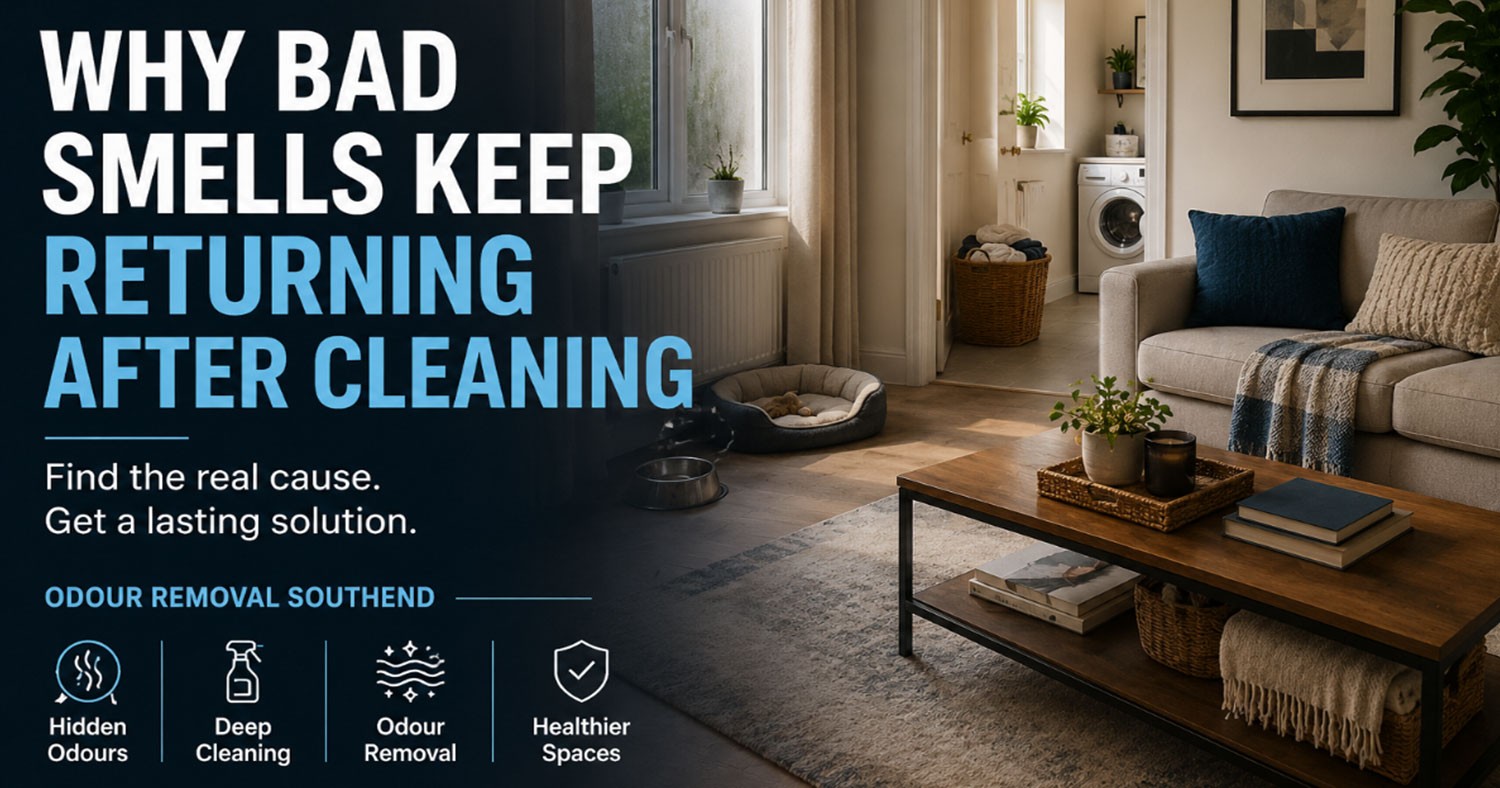
Bad smells that keep coming back after cleaning are usually a sign that the source of the odour has not been fully removed. While surface cleaning can make a property smell fresh temporarily, deeper contamination hidden in carpets, flooring, walls or furniture can continue to release unpleasant odours over time. Professional odour removal identifies and treats the root cause rather than simply masking the smell.
Many homeowners, landlords and property managers are surprised when a property smells clean immediately after a deep clean, only for the odour to return days later. This is particularly common in properties affected by hoarding cleaning Southend, pet damage, smoke, water damage or long-term neglect.
Understanding why odours persist is the first step towards solving the problem permanently.
Why Do Bad Smells Return After Cleaning?
In most cases, odours return because the contamination causing the smell is still present somewhere within the property.
Standard cleaning products work well on visible dirt and surface-level contamination. However, they often cannot reach the materials where odours become trapped.
Carpets, underlay, plasterboard, wood, upholstery and soft furnishings can absorb smells over months or even years. Even after a thorough deep cleaning Southend, these materials may continue releasing odour particles into the air.
This is why a property can look spotless while still having a noticeable smell.
The longer an odour source remains untreated, the more deeply it can penetrate surrounding materials.
What Causes Persistent Property Odours?
Several common issues can create odours that return repeatedly.
Some of the most common causes include:
- Pet urine contamination
- Hoarding conditions
- Food waste build-up
- Smoke residue
- Damp and mould
- Biological contamination
Many of these problems affect areas that are not immediately visible. For example, pet urine can soak beneath carpets and into concrete subfloors, while food waste and organic matter can contaminate floor voids and hidden spaces.
Damp and mould can also create unpleasant smells and may indicate wider health risks in rented housing. The government has published guidance on government guidance on damp and mould, which is useful for landlords and property managers dealing with repeat odour issues.
Without treating the source, the smell often returns regardless of how many times the property is cleaned.
Can Deep Cleaning Remove Every Smell?
Deep cleaning is an important part of odour removal, but it is not always the complete solution.
Some smells require specialist treatment because the contamination has spread beyond the surface. In severe cases, cleaning alone may not be enough to eliminate the problem permanently.
When Specialist Treatment Is Needed
Properties affected by hoarding, unattended deaths, sewage contamination or extreme neglect often require sanitisation and odour-neutralising treatments alongside deep cleaning.
Where cleaning involves biological contamination, chemicals or hazardous materials, safe working practices matter. The Health and Safety Executive provides clear guidance on HSE COSHH guidance, which explains how substances that may harm health should be controlled.
Professional equipment can target odour molecules directly rather than covering them with fragrances. This approach removes the cause of the smell rather than temporarily disguising it.
The result is a cleaner, healthier and more comfortable environment.
Why Hoarding and Gross Filth Properties Often Have Odour Problems
Properties affected by hoarding or severe neglect frequently develop complex odour issues.
Organic waste, spoiled food, animal waste, moisture and poor ventilation can all contribute to persistent smells. Even after large amounts of clutter have been removed, odours may remain trapped in floors, walls and furnishings.
Hoarding can also be connected to mental health difficulties, trauma, grief or isolation. The NHS has helpful information on NHS hoarding disorder, which explains why these situations need sensitivity as well as practical support.
These situations require a structured approach that combines clearance, deep cleaning, sanitisation and targeted odour treatment.
The goal is not simply to improve the smell temporarily. It is to restore the property to a safe and habitable condition.
For landlords, families and housing providers, professional intervention can significantly reduce the time and cost involved in property recovery. It can also support related services such as end of tenancy cleaning Southend when a property needs to be prepared for new occupants.
When Do Landlords and Businesses Need Professional Odour Removal?
Landlords, letting agents and business owners often need professional odour removal when a property cannot be reoccupied, re-let or used safely.
For rental properties, persistent smells can delay viewings and create complaints from new tenants. In commercial settings, odours can affect staff, customers and visitors. This can be especially important for shared buildings, offices and customer-facing premises.
Professional support may be needed after long-term neglect, hoarding, pet damage, smoke exposure, damp, waste build-up or contamination. The UK Health Security Agency also provides advice on UKHSA cleaning and disinfection guidance, which is useful when thinking about cleaning, disinfection and safe property use.
For businesses, regular office cleaning Southend can help prevent odour issues from building up in kitchens, washrooms, bins, carpets and communal areas.
Here are some common questions people ask about persistent property odours.
Frequently Asked Questions
Why does my house smell bad even after cleaning?
A property may still smell after cleaning if the source of the odour remains hidden beneath surfaces or inside materials such as carpets, upholstery or flooring. Surface cleaning removes visible dirt but does not always remove contamination that has been absorbed over time.
Can professional cleaning remove pet odours?
Yes. Professional cleaning can often remove pet odours, but severe contamination may require specialist treatment. Urine can penetrate beneath carpets and into subfloors, making standard cleaning methods ineffective.
Are odour removal treatments safe?
Professional odour removal treatments are designed to be used safely within residential and commercial properties. Reputable cleaning companies will explain the process and ensure treatments are suitable for the environment.
How long does odour removal take?
The timeframe depends on the cause and severity of the odour. Some properties can be treated in a single visit, while more complex situations may require multiple stages of cleaning and treatment.
Can hoarding cause long-term odour problems?
Yes. Hoarding conditions often allow odours to build up over many years. Waste, food debris, moisture and contamination can become embedded in materials throughout the property, making specialist cleaning and odour treatment necessary.
Professional Odour Removal in Southend
Persistent smells are often a sign of a deeper problem that standard cleaning cannot fully resolve. Understanding the source of the odour is the key to achieving a lasting solution and restoring a property to a clean, healthy condition.
At AA Cleaning Services, we help homeowners, landlords, letting agents and housing providers tackle challenging cleaning situations across Southend and the surrounding areas. From odour removal and deep cleaning to hoarding and property recovery services, our team provides practical solutions for even the most difficult environments. Contact us today for confidential advice and support.